
A Coin Toss Moment for Public Interest Journalism: How Deep Collaboration Can Help Heal a Broken Information Ecosystem
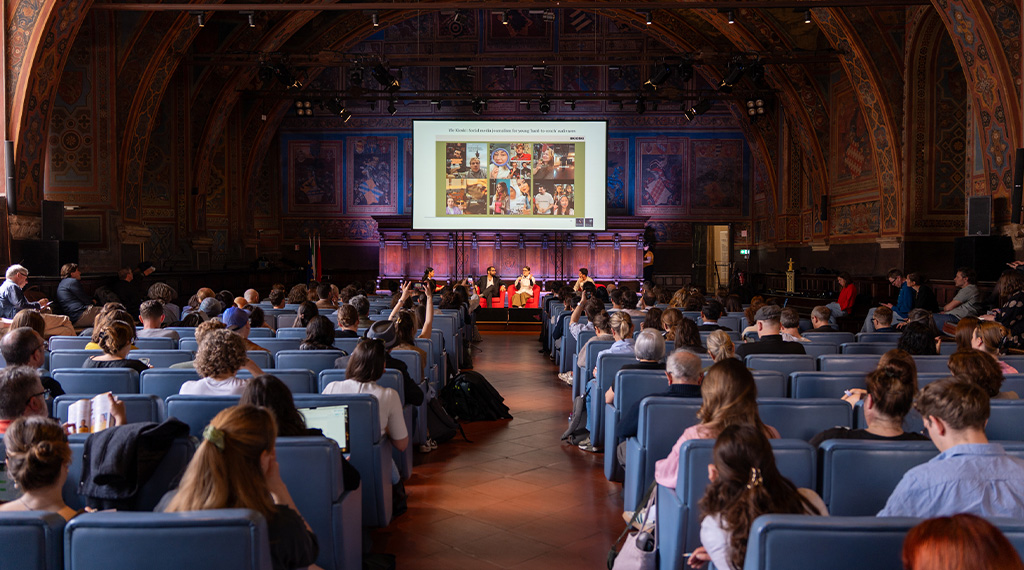
Collaboration is a strategy for survival, and it would require greater coordination efforts from journalism funders, Florence Wild, Chief Development Officer at CORRECTIV argues.
My first meeting at this year’s International Journalism Festival in Perugia really struck a chord. It was an encounter with the leadership team of Sinatle Media, an initiative of 22 independent media outlets from Georgia that formed shortly after the government introduced a new set of restrictive foreign agent and grant laws which effectively cut off independent media from any kind of international funding.
I was deeply impressed with the group of young women’s resolve to defy the government’s increasingly authoritarian tactics, and with the network of solidarity they had built among the group of media outlets. You see, media organisations and journalists can be quite finicky when it comes to cooperation – in diplomatic terms, I’d say our sector runs on friendly competition, in the best of times. Yet we are most decidedly not in the best of times. Still, Georgian media were not only collectively fundraising, but the Tbilisi-based outlets were also forfeiting their shares so that their colleagues from more rural parts of the country could keep the lights on.
It’s a beautiful and moving example of deep collaboration in a situation that feels impossible. Teo Kavtaradze, one of Sinatle Media’s co-founders, later re-shared the story at a workshop on unconventional approaches to collaboration that I co-hosted together with Rozina Breen, Director of Editorial Programs at the Pulitzer Center. All of us were picking up on the same need and the same trend: that collaboration in this day and age is not a nice to have, it’s a strategy for survival.
Collaboration as Infrastructure
The term “collaboration” is of course rather vague, capturing any kind of instance in which two organisations or organisational units align themselves to achieve a common goal. This can take place anywhere between the project-based short term to more permanent forms of working together.
Journalism funders have played a big part in advocating for more collaboration in the sector – for example by enabling cross-border investigations and cross-sectoral initiatives, bridging journalism, academia, and the arts. This has no doubt helped to bring the sector closer together. Building trust is the first stepping stone from one-off projects towards deeper and more catalytic ways of collaborating that can lead to sector-wide renewal. My prediction: Amidst shrinking spaces and resources, we’ll start seeing a lot more of the more structural and permanent forms of collaboration, including mergers.
Exactly two years ago, one of the most exciting examples of deep collaboration, the Journalism Cloud Alliance, was officially launched at the International Journalism Festival with the ambitious goal of building a community-owned cloud infrastructure. Led by the Global Forum for Media Development (GFMD) and the Organized Crime and Corruption Reporting Project (OCCRP), the Alliance now consists of 37 members spread across all six continents (disclaimer: this includes CORRECTIV) as well as 17 partners from academia, philanthropy and technology.
It stands out to me because the focus so clearly is to build a shared infrastructure for independent journalism at a time where Big Tech companies have turned increasingly and outwardly hostile towards fact-based discourse and the idea that information as a public good is worth safeguarding. The JCA is an investment into the health of the information ecosystem and the underlying infrastructure that all organisations whose mission is to provide information in the public interest depend on. Philanthropic funding has kick-started this endeavour which would not have been possible under normal market conditions.
Collaboration as Leverage
Another interesting field of collaboration next to shared services and infrastructure is collective bargaining and advocacy. The Danish Press Publications Collective Management Organisation (DPCMO) which accounts for 99% of the Danish news media landscape, for instance successfully negotiated a collective licensing agreement with Google in 2023. As of 2026, DPCMO is taking OpenAI to court over compliance issues with Danish copyright law, transparency and fair compensation over the use of protected works.
Initiatives similar to DPCMO have emerged in other countries in recent years, some of which to date have stalled precisely due to lack of funding. While the Danish example is primarily financed by membership fees, philanthropy could play a key role in supporting initiatives in other markets, including covering costs for setting up governance structures, legal consultation, and convening members.
I’d actually heard about the DPCMO example at a side event in Perugia on Big Tech reporting organised by Agência Pública, CLIP (Centro Latinoamericano de Investigación Periodistica), Lighthouse Reports, and Democracy for Sale. Part of the afternoon showcased the reporting from the cross-border investigative project “The Invisible Hand of Big Tech” which brings together 18 media organisations from 13 countries, led by Agência Pública and CLIP.
In terms of methodology, cross-border investigations and investigative networks are of course not new (this makes any successful collaborative investigation no less impressive, there absolutely is an artistry behind it). But for the purpose of this article, the Invisible Hand project stands out in particular because it dares ask some uncomfortable questions to journalists, media outlets, and media support organisations that have in the past benefitted from the once highly lucrative and sought-after funding from Big Tech companies. Beyond the powerful reporting it produces, the project provides a space for self-reflection and reaches out another “invisible hand” to investigative journalists and media organisations around the world, inviting them to collaborate in defence of democracy under attack.
The Role of Journalism Funders
This year’s International Journalism Festival left me feeling energised, despite the abundance of challenges and outright attacks our sector is facing. There’s an incredible appetite for creativity to build on, a willingness to learn from one another, and a moral conviction to serve communities even more deeply through these times of turmoil. Collaboration comes into frame not merely as a prerequisite for funding but an existential necessity – whether the aim is to pool and distribute resources, build shared infrastructure, collectively advocate for better regulatory frameworks, grow editorial capacity, or to better reach and serve audiences.
Given the complexity of the task at hand, this would require greater coordination efforts on the part of journalism funders themselves. After all, if we are serious about journalism as a public good, the focus should not solely be on the ability (or inability) of single media organisations to survive. Our conversation as a sector should also include an angle on ecosystem health and the connective tissue between media organisations.
As we enter a new era of collaboration for journalists and media organisations, it is important for journalism funders to reflect on how they can create an enabling environment that feels supportive rather than prescriptive. As outlined, collaboration can and must take on different forms beyond a project-based logic if we are to make any real advances on the underlying systemic issues. One of the participants of our workshop put it best when she stated: “The risk of not collaborating feels much higher to me now than the risk of not moving at all.”