

Reaching young people has become a strategic priority for Public Service Media (PSM) in many Western countries, as these organisations face challenges in engaging those audiences with the news. To expand their reach, PSM organisations often rely on social media platforms. However, this reliance creates dependencies on platforms like Facebook, Instagram, and Snapchat. These platforms are driven by commercial interests, leading to datafication and algorithmic filtering, which do not align with the values driving PSM, such as universality, independence, diversity, and accountability. As gatekeepers, these platforms significantly influence news dissemination, posing challenges to journalistic integrity and PSM’s core ideals. These concerns are particularly relevant given the central role of digital intermediaries in reaching youth.
This study focuses on the Norwegian Broadcasting Company (NRK), Norway’s public service media (PSM) organisation, and its efforts to target young audiences on Snapchat. Despite the global popularity of TikTok, Snapchat remains a major platform in Norway, particularly among young adults. As scholarly research on how newsrooms navigate Snapchat’s rules and metrics for disseminating news is limited, this study aims to fill that gap by exploring how journalists produce news for Snapchat, while adhering to PSM obligations and examining the implications for content dissemination and audience reach.
The research uncovers complex gatekeeping processes throughout the publication process, referred to as “dynamic gatekeeping,” in which journalists navigate Snapchat’s algorithmic gatekeeping. This involves interpreting audience metrics, adhering to Snapchat’s guidelines, and responding to audience reactions as seen in analytics. NRK’s news flow on Snapchat involves a reciprocal relationship between journalistic decisions and platform algorithms. The study identifies three key gate-keeping stages: pre-publication, publication-stage, and post-publication.
In the pre-publication phase, journalists at NRK UNG (NRK Youth) use Snapchat metrics from the Story Studio to prioritise and produce news stories. This data provides detailed information about the audience and influences decisions on news topic selection and presentation. The goal is to maximise engagement from the target youth demographic. The newsroom monitors metrics such as click-through rates, reading times, and audience demographics. They adjust the content to align with audience preferences and algorithmic influences. Despite relying on these metrics, journalists argue that they prioritise independent editorial decisions based on news values and ethics.
During the publication stage, Snapchat’s algorithms directly influence the selection of “tiles” (front page visuals for Snapchat editions) through ABCD testing. This testing helps determine which tile will engage the audience most effectively, influencing the prominence of specific stories. The newsroom creates multiple tiles for each story and uses algorithmic feedback to improve future editions. This process highlights the interplay between the platform’s algorithmic decisions and journalistic content creation.
Post-publication, Snapchat’s flagging system enforces community guidelines by restricting the dissemination of content deemed inappropriate. This flagging often frustrates journalists, as it limits the reach of what they believe to be important stories. Violations, such as those related to graphic content or commercial elements, result in flagged stories that only reach existing subscribers. Journalists adapt by modifying content to avoid flagging but express concerns about the inconsistent enforcement of guidelines and its impact on editorial integrity.
The study examines the complex and ever-changing relationship between PSM journalists and Snapchat’s algorithmic gatekeeping. It underscores the difficulties of upholding journalistic independence while reaching out to younger audiences on external platforms. These findings call for careful consideration of the implications for PSM’s editorial autonomy and the credibility of their news coverage. As PSM organisations grapple with these challenges, the study recommends additional research into the broader effects of platform algorithms on journalistic methods.
Røsok-Dahl, H., & Kristine Olsen, R. (2024). Snapping the news: Dynamic gatekeeping in a public service media newsroom reaching young people with news on Snapchat. Journalism, 0(0). https://doi.org/10.1177/14648849241255701

Amidst a global rise in news avoidance, an increasing number of journalists and researchers map its implications and underlying causes. As a response, a number of strategies are being proposed to re-engage with audiences and reaffirm the value of professional journalism.
The global increase in news avoidance is causing concern among journalists and media researchers alike. To understand the phenomenon, it is important to distinguish between selective and consistent news avoidance, as each has its own reasons and consequences. Selective avoidance, often attributed to news fatigue and information overload, involves steering clear of specific topics or sources rather than entirely shunning the news. Consistent news avoidance is more concerning, indicating minimal engagement with news in general.
According to the 2023 Digital News Report by Reuters Institute, financed by Google, the proportion of those who avoid news, either consistently or occasionally, is close to all-time highs of 36% across various markets. Selective news avoiders follow various strategies, including avoiding news on certain channels such as the radio or social media, as well as more specific actions like reducing news checking frequency or avoiding certain topics like the conflict in Ukraine or national politics.
Benjamin Toff, assistant professor at the Hubbard School of Journalism & Mass Communication at the University of Minnesota, points out that there is less data on consistent news avoidance, which is a particularly concerning trend in countries like the UK and US where it has risen to 7%. “In anti-democratic countries there is also a correlation between lower press freedom and higher news avoidance, because news is perceived as less reliable and less trustworthy,” Toff said, adding that data about the phenomenon in highly autocratic countries are scarce.
There are various reasons behind the increase of news avoidance. Toff explained that selective news avoidance is a response to information overload and the complexities of today’s media landscape, reflecting a general disengagement from news. This phenomenon is closely intertwined with digital infrastructure and with people’s identities and ideological beliefs, shaping their perception of the world.
In a survey conducted in the Netherlands, researchers identified seven distinct profiles of news avoiders, each with its own set of characteristics and motivations. These profiles range from those who occasionally avoid news due to concerns about its quality or its negative impact on their emotions to those who prefer alternative media sources. Among these profiles are also those who feel indifferent towards news, or find it challenging to engage with. Additionally, there are those who hold negative sentiments toward news, often driven by political ideologies.
News avoidance is more prevalent among younger generations, Toff said, as well as among women and those with lower levels of education and socioeconomic status. There is no specific data linking the growing popularity of TikTok to the increasing tendency of younger audiences to access news through the platform, a trend that suggests a weakening connection to traditional news brands. Yet, there is a perception among these audiences that traditional news habits are outdated and a belief that news will naturally come to them.
News avoidance can have serious societal consequences. Toff noted a strong correlation between political engagement and news consumption. “Political coverage often requires a significant level of background knowledge, it is like tuning in to Episode 3 in Season 4 of Game of Thrones, without knowing what happened in the show before,” he said. Since news avoidance is particularly prevalent among disadvantaged groups in the society, it poses a risk of widening existing inequalities by further skewing mainstream journalism towards privileged audiences.
As publishers have recognised the urgency of the issue, many started to devise strategies to address it. Researchers have also proposed several research-backed steps that journalists and editors can take to effectively counteract news avoidance.
One crucial aspect involves responding to how news makes people feel emotionally, Toff said. News organisations should acknowledge common complaints about news being depressing, irrelevant, or overwhelming. By presenting uplifting, relevant, and accessible content that resonates with people’s lives, they may attract audiences who previously avoided news products. Additionally, efforts to engage news avoiders should prioritise representing and respecting diverse groups, fostering a sense of inclusion and relevance.
To make news more accessible for consistent avoiders, simplifying news content and formats is essential. Offering summary pieces, providing background and context for stories, and personalising news delivery based on individual interests and levels of background knowledge can help engage audiences who may feel overwhelmed by traditional news formats.
Furthermore, educating the public about the value of journalism and promoting innovative news formats are also important steps in countering news avoidance. Actively listening to audience feedback is a key component of successful engagement strategies.
Ultimately, countering news avoidance requires an all-purpose approach involving news organisations, especially public service media, non-profits, and even civic organisations and universities that can offer media literacy training, according to Toff. By making news content more visible and relevant to everyday life, reaching audiences on their preferred platforms and in preferred formats, and emphasising the social benefits of news consumption, publishers can attempt to re-engage audiences and reaffirm the importance of professional journalism.

In an era where the value of journalism is increasingly scrutinised, understanding its impact presents a complex puzzle. From traditional metrics to innovative methodologies, the quest to measure impact evolves, with new tools emerging.
Both journalists and donors recognise that the media operates within a larger ecosystem, making it difficult to isolate and measure the precise impact of journalism. Furthermore, impact can vary significantly depending on the goals and priorities of different journalists and newsrooms. For instance, while one news organisation might prioritise educating its audience and measure impact by assessing changes in public opinion on contentious issues, other outlets may focus on different indicators.
Still, journalists and media organisations worldwide are engaged in assessing the impact of their work, driven by a dual motivation of self-evaluation and the need to demonstrate value to donors, investors, and the public. Increasingly, media outlets recognise that communicating the positive outcomes of their work not only boosts trust and loyalty among audiences but also holds potential for revenue growth.
This shift reflects a common belief among funders that investing in journalism requires tangible evidence of impact, moving beyond viewing it solely as a public good. Such recognition underscores the need for donors to evaluate their investments in media and journalism programmes thoroughly.
Insights into measuring impact, such as those outlined by the International Journalists’ Network, highlight its multifaceted nature, encompassing not only the dissemination of information but also its broader societal effects. From shaping public opinion and encouraging public discourse to driving policy change, the impact of journalism spans various phases, often defying simple cost-benefit analyses. Moreover, methodologies for measuring impact extend beyond traditional metrics like online engagement, with a broad range of tools developed by academics. Add to that cross-border collaborations, or even negative consequences, such as potential backlash against journalists.
To analyse impact, there are a lot of different studies across various fields like economics and political science, focusing on topics from government spending and corruption to voter behaviour, argues Anya Schiffrin, director of the media, technology, and communications specialisation at Columbia University’s School of International and Public Affairs (SIPA), adding that these “measurement tools are becoming more and more sophisticated.”
The Impact Dashboard, developed by Pluralis in collaboration with the Media and Journalism Research Center (MJRC), is one of such tools. It evaluates supported media organisations across three key dimensions: long-term sustainability, plurality, and accessibility to information, analysing impact on three levels. On the micro level, it tracks how supported organisations change in terms of revenues and audience reach over the course of working with the funder. On the meso level, the Dashboard collects evidence to measure the level of media plurality in the country. Finally, on the macro level, it examines the impact on society, searching for evidence such as potential policy changes resulting from coverage by the media receiving the grant.
Another approach is proposed by Schiffrin, who, with Andre Correa d’Almeida, Lindsay Green-Barber, Adelina Yankova, and Dylan W. Groves developed a multi-faceted metric system to analyse media impact. As they argue, three primary research strands contribute to understanding media impact: social scientists focus on identifying causal effects, often related to citizen knowledge, attitudes, and government responses; media researchers offer accounts of causal processes and diverse media effects; and media practitioners provide an insider’s view, highlighting the impact on journalists and media organisations. These approaches can complement each other, hence their proposed taxonomy that can unify measures of media impact, and inform decisions by practitioners and donors.
The taxonomy comprises three levels of impact. At the individual level, media reports influence beliefs, attitudes, and behaviours. The network/organisation level involves the collective impact on social networks, norms, and actions, including effects within media organisations and journalist communities. The institution level pertains to long-term effects on institutions and culture. The taxonomy also distinguishes between external impact on society and internal impact within the journalism community, providing a framework that can be adapted to different objectives, acknowledging the diverse goals of donors, activists, journalists, and media outlets. “One can look at the table and then measure those metrics their organisation cares about,” Schiffrin said.
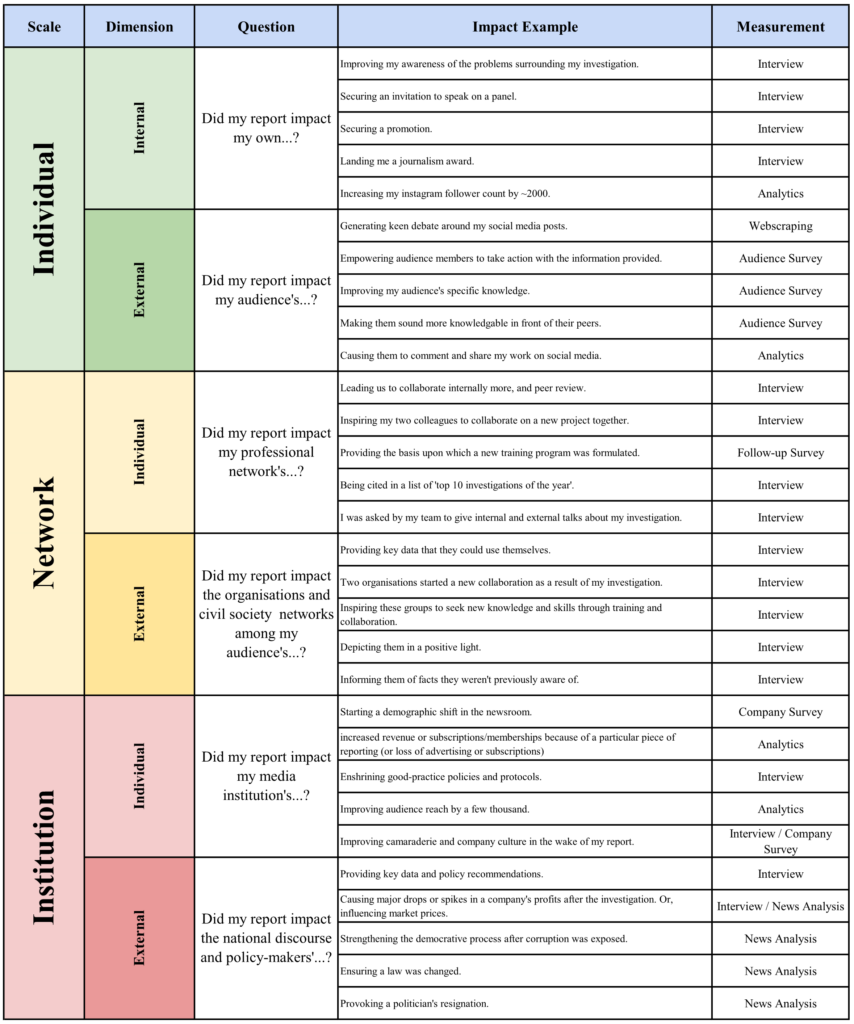
In evaluating the impact of journalism, it is important to recognise that some news organisations have smaller audiences rendering metrics like pageviews or listenership alone inadequate. Furthermore, while one traditional measure of journalism’s impact involves influencing government policy or prompting officials to address issues, achieving such outcomes often demands sustained reporting over an extended period.
Furthermore, in countries with more autocratic rulers and intensified attacks on journalism, government responses to policy concerns or official misconduct exposed by investigative reporting cannot be expected. In fact, in such landscapes if donor funding contributes to the survival of a news organisation, it can already be perceived as having a significant impact. “It is important to keep the flame alive,” Schiffrin said. “You don’t want these outlets to die.” She added that, when measuring impact, journalism donors should avoid burdening grantees with overly demanding reporting requirements, focusing instead on listening to their feedback.

The landscape of local journalism is undergoing a critical transformation marked by dwindling revenues, job cuts, and closures, primarily attributed to the digitisation of information environments. This shift prompts a crucial question: How can local media outlets adapt to the digital era to retain or regain audiences and, consequently, attract advertisers? This study, conducted in Denmark by Lene Heiselberg and David Nicolas Hopmann (Centre for Journalism at the Department of Political Science and Public Management, University of Southern Denmark), employs a mixed-methods audience research approach to unravel the desires and needs of local journalism audiences, exploring functional, symbolic, emotional, and economic values.
Local journalism, vital for community cohesion, faces a challenging cycle where declining resources lead to lower-quality content, further driving audiences away and diminishing revenues. The 21st century, characterised by the dominance of the Internet and social media, poses unprecedented challenges to traditional local media, contributing to the rise of ‘news deserts,’ areas devoid of continuous journalistic coverage. This decline threatens democratic systems, accountability, and crucial local information.
The study distinguishes three audience categories: non-paying, potential-paying, and paying. While all prioritise informative content, paying audiences emphasise symbolic and emotional values, seeking a sense of belonging and personally meaningful content. Non-paying audiences stress the need for improved quality.
Quantitative analysis reveals that 61% of participants are unwilling to pay for local journalism, while 28% are potentially willing, and 11% are already paying. Surprisingly, the perceived relevance of being informed about local affairs is high across all groups, challenging the notion that non-paying audiences don’t value local news. Participants who do not want to pay for local news do not express wants and needs for symbolic and emotional values of local journalism to the same degree as participants who (might) pay for local journalism. Instead, participants who do not pay and participants who might pay emphasise functional values.
The results of the research conducted for this study indicate three paths for local media outlets to increase their audiences: (1) communicate and/or clarify the symbolic and emotional values of local journalism, (2) increase quality regarding the functional values of local journalism, and (3) increase relevance regarding the functional values of local journalism.
Few quotes touch upon the economic value of local journalism, with business owners recognising the relevance of staying informed about local events for economic gain. The study suggests that revitalising local journalism requires prioritising unique, emotionally engaging content, clarifying symbolic values, and enhancing functional quality. Understanding audience preferences is crucial for local media outlets to refine their strategies and to ensure the survival and relevance of local journalism in the digital age.
Heiselberg, L., & Hopmann, D. N. (2024). Local journalism and its audience. Journalism, 0(0).
https://doi.org/10.1177/14648849231173226